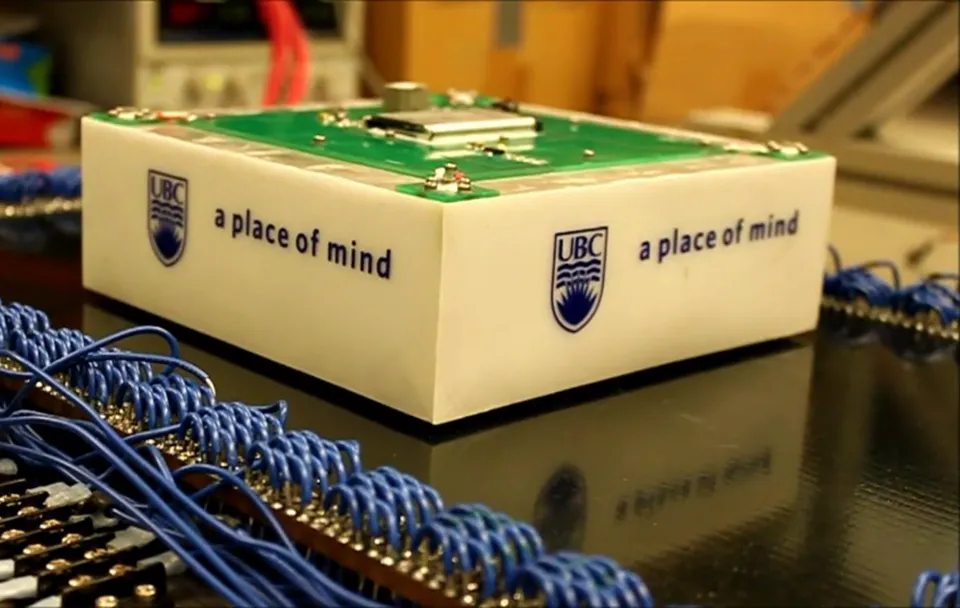
Prototype developed at Dr. Lu's UBC lab (2011)
History
The development of magnetically levitated planar motors dates back to 1997, when Dr. David L. Trumper’s lab at MIT first demonstrated simultaneous motion in both the X and Y directions over a one-inch by one-inch stroke—achieved without any mechanical bearings. Building on this foundation, Dr. Xiaodong Lu—who would later become the founder of Planar Motor Inc.—continued advancing the technology at the University of British Columbia (UBC) after completing his PhD in Trumper’s lab. Years of dedicated research led to a major breakthrough in 2011 with the development of a long-stroke planar motor prototype that uses linear coil arrays on the stator and linear magnet arrays on the mover. This innovation showcased the potential for virtually unlimited travel and the coordinated operation of multiple movers, marking a pivotal advancement in planar motor technology. Recognizing its commercial promise, the invention was licensed by UBC to several companies, including Beckhoff Automation, which began development in 2014 of what would later become the XPlanar system.